
What two months of records revealed about cyber charter schools…..
Over the past several weeks, Education Voters of PA has reviewed and shared information from cyber charter board meetings. For many schools, these records can only be obtained through Pennsylvania’s Right-to-Know Law. As a result, we have submitted Right-to-Know requests month after month to obtain the records needed to better understand how cyber charter schools operate and how public education dollars are being spent.
Throughout this series, we have tried to keep one principle at the center of every email: let the records speak for themselves.
At a time when cyber charter schools are publicly claiming that recent funding reforms are creating financial hardship, their own records tell a more nuanced story. These records show millions of dollars spent on advertising, major investments in real estate, lavish spending on field trips, and significant differences in enrollment trends across schools. At the same time, data continues to show that cyber charter graduation rates lag far behind state averages and that many cyber charter schools’ proficiency rates remain among the lowest in the commonwealth.
These records provide important context for many of the claims currently being made about cyber charter schools. Taken together, they paint a more complete picture than headlines or social media posts alone.
1) Enrollment Matters.
Understanding each cyber charter’s financial position requires looking at both enrollment trends and the school’s own financial records.
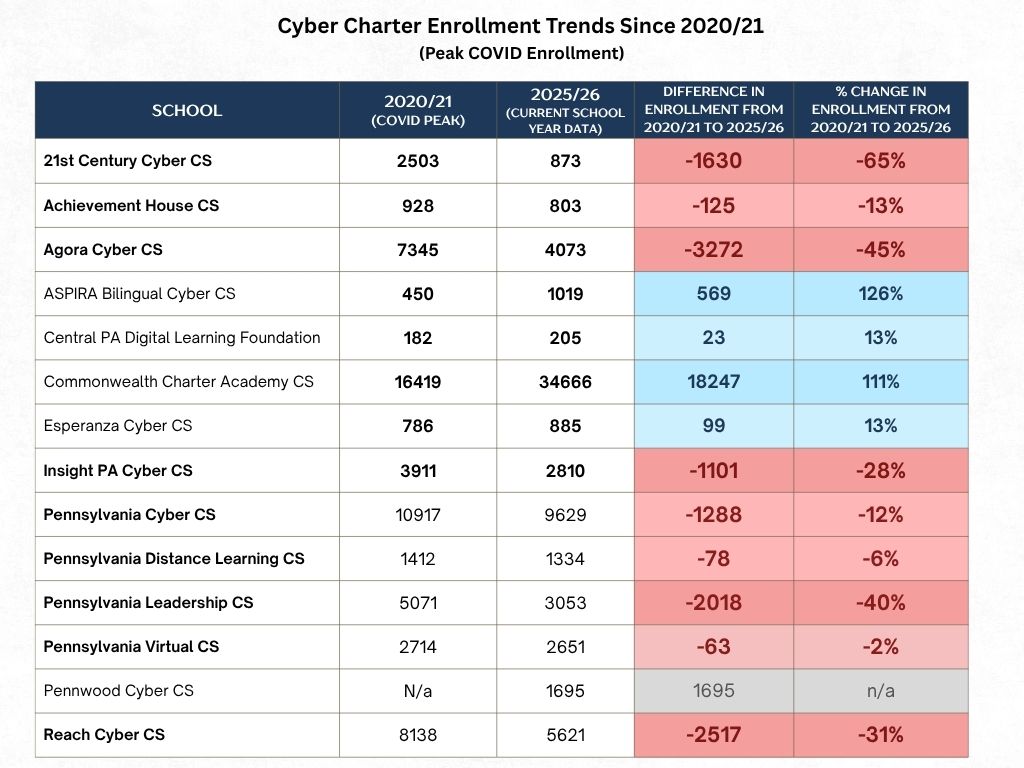
Cyber charter funding is based largely on the number of students they enroll. Since the peak of the COVID-19 pandemic, some cybers have lost thousands of students, while others have continued to grow.
The first question anyone should ask when a cyber charter says it is experiencing financial problems is, “Is your school losing student enrollment?” If the answer is yes, the cyber’s enrollment loss is likely the most important factor contributing to cyber’s financial issues.
For example, Commonwealth Charter Academy’s own budget forecast projects more than $117 million in additional revenue compared with its original budget for 2025-2026 because enrollment exceeded expectations—even after the tuition reforms enacted in the state budget in November of 2025. CCA continues to be awash in excess funding. Cyber charters that have experienced enrollment declines face very different financial realities as they have lost students and the tuition payments that accompany them.
2) Cyber Charter Student Outcomes Remain Abysmal
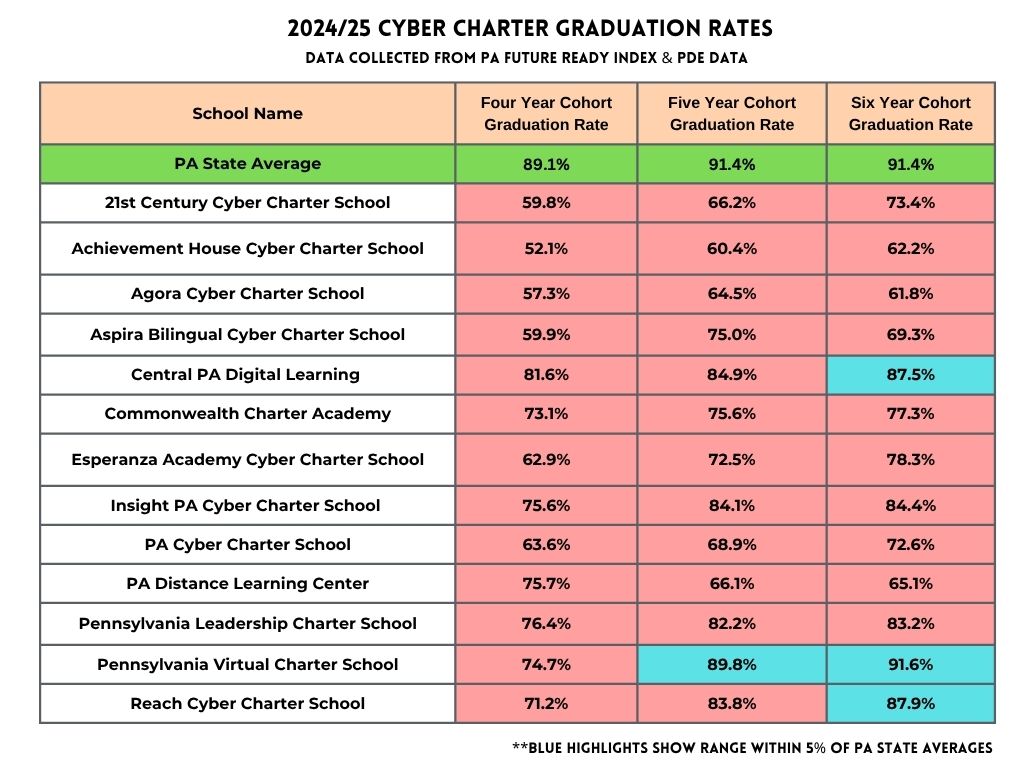
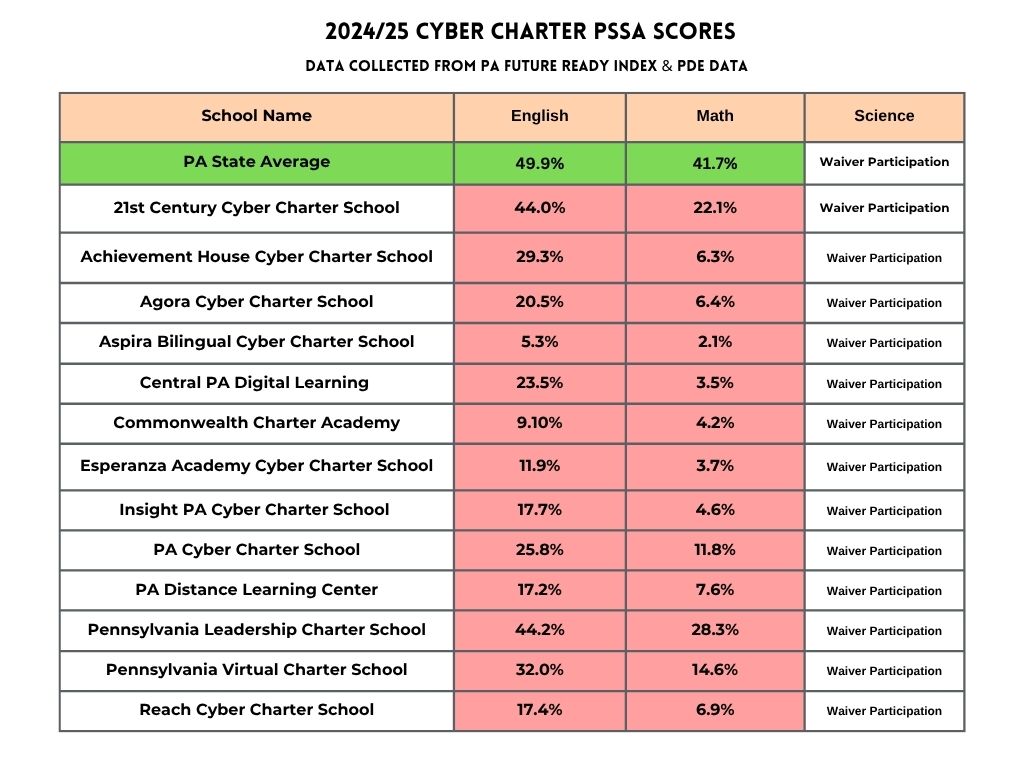
Public records show that while results vary from school to school, student proficiency rates at many cybers remain among the lowest in the commonwealth and graduation rates trail state averages, often by double digits.
The cyber charter industry has no shortage of excuses to justify these abysmal results. What is missing are concrete plans to improve them.
3) Many Cyber Charters Operate with Little Transparency
While some cyber charters post contracts and financial documents that their board approves online together with their board agendas, others release these documents only after receiving a Right-to-Know request, which can take more than a month to fulfill. It should not have to take Ed Voters to create a Cyber Charter Transparency Hub in order to have these documents be readily available for the public.
Cyber charter schools are public schools. State law must require the financial documents and contracts that cyber charter boards approve to be posted online with their board agendas so that parents, taxpayers, and policymakers can have a real understanding of how the cyber industry spends more than $1 billion in funding that it receives from school districts across the commonwealth each year.
4) Public Records Raise Legitimate Questions About Facility Investments
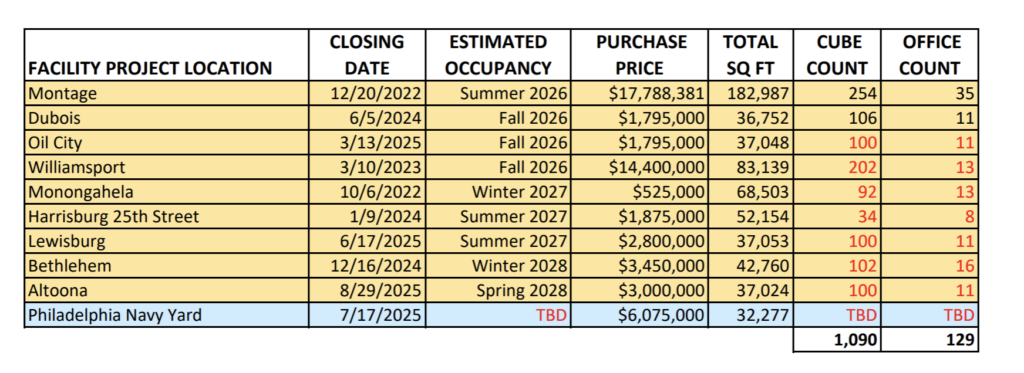
Board documents and property records show that some cyber charter schools continue to make significant long-term investments in real estate. In one recent example, Commonwealth Charter Academy’s own board documents identified more than $53.5 million in properties recently acquired or planned, in addition to the facilities it already owns and leases.
Those same records show large differences in how existing facilities are being used, with some locations containing tens of thousands of square feet while listing relatively small numbers of staff.
A February 2025 performance audit of CCA conducted by Auditor General Timothy DeFoor states, “Building acquisitions and operations of this magnitude raise concerns about the appropriateness of these expenditures and whether they align with the online platform unique to cyber charter schools, and ultimately, the intent of the CSL to provide online learning opportunities accessible to all students throughout Pennsylvania regardless of their geographic location.”
Pennsylvanians, whose property taxes are being used to fund hundreds of millions of dollars spent on the construction and renovation of buildings owned by cyber charters, have a legitimate interest in understanding these expenditures.
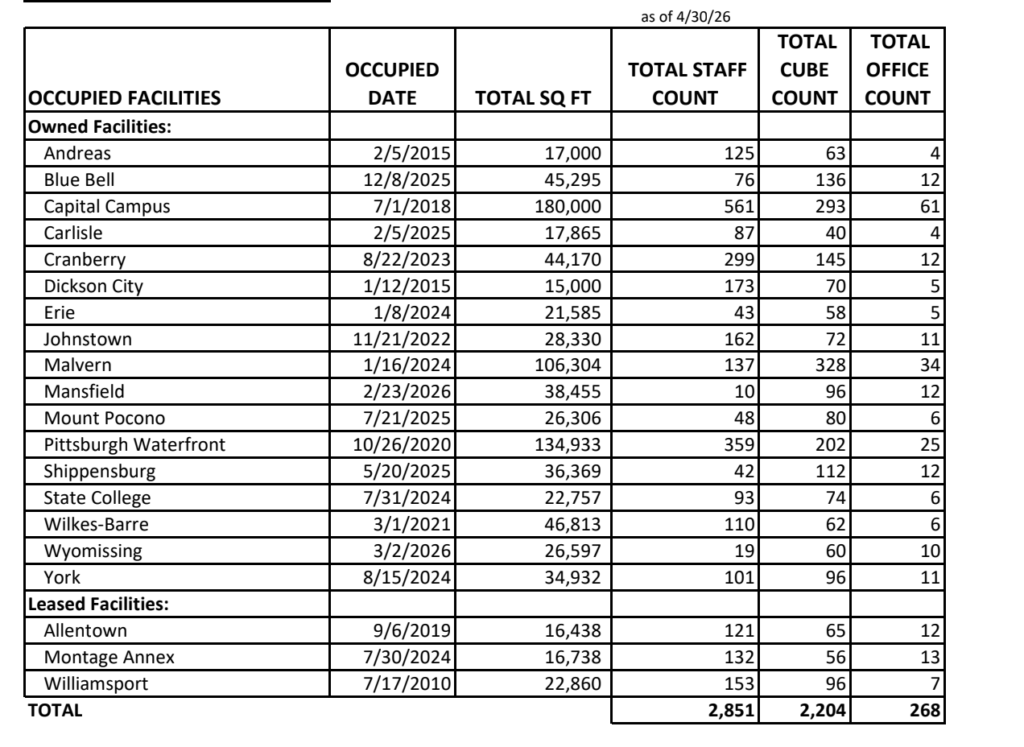
As policymakers consider how tax dollars are invested in public education and specifically in cyber charter schools, they must take into account a large amount of nuanced information.
Our team at Education Voters of PA is committed to creating transparency around cyber charter spending and providing context that paints a more complete picture than headlines or social media posts alone.