
Some state lawmakers recently introduced and co-sponsored House Resolution 489, “Recognizing the 25th Anniversary of Pennsylvania’s Educational Improvement Tax Credit (EITC) Program.”
The 2025-2026 state budget allocated $680 million to fund the Educational Improvement Tax Credit (EITC) and Opportunity Scholarship Tax Credit (OSTC) programs, which provide $575 million to fund vouchers for private/religious schools, $74.5 million to fund “educational improvement organizations,” and $30.5 million to fund scholarships for pre-K programs.
Click HERE to read our FAQ document about the EITC and OSTC programs.
The co-sponsorship memo to recognize these programs includes the following:
The EITC program also demonstrates how public policy can encourage private investment to expand opportunity without increasing taxes or creating new government bureaucracy. Pennsylvania businesses voluntarily contribute to scholarship organizations, helping students succeed while strengthening communities across the Commonwealth.
We have a serious problem if state lawmakers think tax credit programs are private investments that have no impact on the state budget.
This is basic math.
The money used to pay for tax credits does not magically appear or grow on trees. Every dollar that is spent on a tax credit is removed from the state budget. This leaves less money available to fund programs that benefit all Pennsylvanians.
Let’s be crystal clear, individuals and businesses that participate in Pennsylvania’s Educational Improvement Tax Credit (EITC) and Opportunity Scholarship Tax Credit (OSTC) programs are NOT making private donations. They are choosing to divert up to 90% of their Pennsylvania tax liability OUT of the state Treasury and INTO an organization of their choice.
Further, such “philanthropic” contributions are likely to lower federal taxes for those who pay them. After getting both a state and federal tax break, some may not be making any net contribution at all or even be “cash flow positive.”
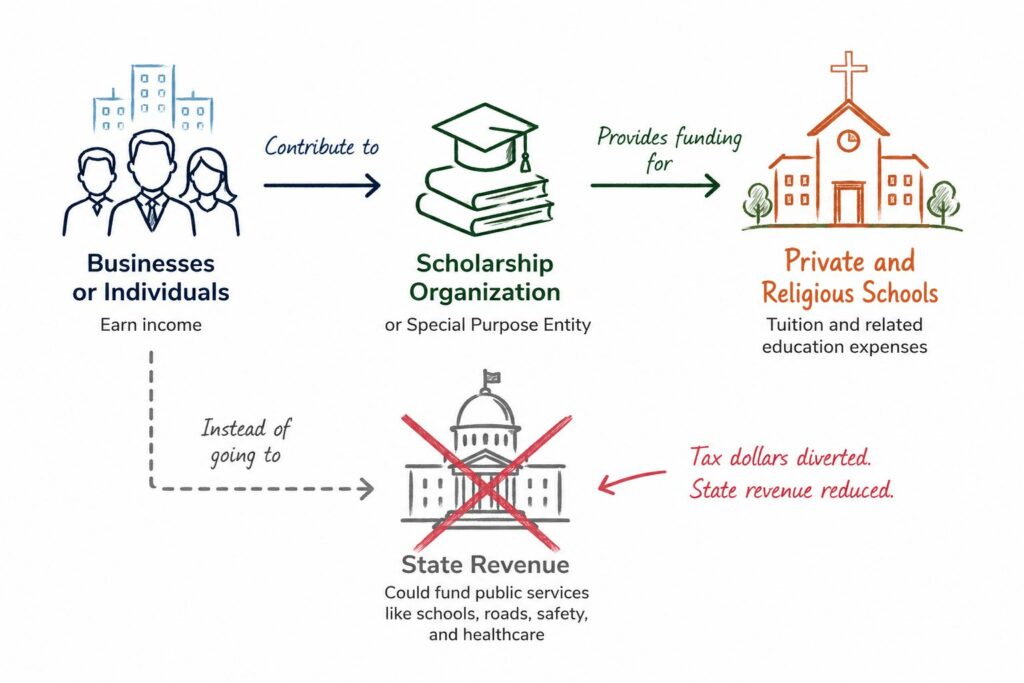
Since 2001, the state legislature has allocated more than $3.5 billion through the EITC/OSTC programs to pay for private/religious school vouchers. The state law governing these programs is intentionally designed to prevent the collection of data that would allow lawmakers and the public to understand who benefits and what impact – positive or negative – spending billions of tax dollars has had on student academic outcomes.
What we know:
- Students who are already attending private/religious schools are eligible to receive EITC/OSTC vouchers.
- Private and religious schools that receive diverted tax dollars through the EITC/OSTC programs are allowed to discriminate against and refuse to enroll and/or expel students for almost any reason, including pregnancy, sex, disabilities, sexual orientation, religious beliefs, socioeconomic status, behavior, gender identity or expression, and more.
- Pennsylvania’s most elite and expensive private schools receive tens of millions of dollars in EITC/OSTC voucher funding every year.
- Scholarship organizations are allowed to keep up to 10% of the contributions they receive. They are not required to report how they spend this money.
What we don’t know:
- How many students from low-income families have used EITC/OSTC vouchers. The state is prohibited from collecting information about family income levels.
- If vouchers are awarded to families whose income exceeds the program limit of $156,911 for a family of four. Scholarship organizations do not have to report family incomes and there are no audits to ensure their compliance with the law.
- How many students would attend private/religious schools even without the vouchers.
- What impact spending $3.5 billion on school vouchers in Pennsylvania has had on student achievement – positive or negative. The state is prohibited from collecting information about the academic achievement of students who receive EITC/OSTC vouchers to attend a private/religious school.
Instead of supporting a resolution recognizing a tax credit program that has funneled more than $3.5 billion into private and religious schools with virtually no accountability or transparency, we urge state lawmakers to enact reporting requirements that will allow Pennsylvanians to understand if spending all of this money on private school vouchers has actually been worth it.
Want to learn more about Pennsylvania’s EITC/OSTC school voucher programs and what a federal school voucher program would mean for Pennsylvania?
Click HERE to sign up for a webinar on May 21st.
Thank you for your continued commitment to public education.